
Turn your team’s engineering best practices into automated checks. Review AI-generated code with standards you own and control.
Open source · MIT licensed · Bring your own AI provider
Versioned Markdown policies in your repo
Architecture, security and engineering practices
Findings with evidence. Fixes with an agent.
AI can generate a pull request in minutes. Understanding it still takes focus. OpenShrike turns your engineering standards into repeatable checks, so reviewers can spend their attention where it matters.
checks in the open library
engineering domains covered
open source and yours to adapt
your AI provider, your choice
Architecture decisions, security practices and code conventions belong in your repository. Write them as Markdown, version them with your code, and turn them into checks your team can run.
Relax a requirement, tighten a rule or add a new policy by editing a file—or asking your coding agent to help.
Explore Markdown-driven checks →Domain code should not depend on the web framework or persistence layer.
Linters check syntax. Tests verify behavior. OpenShrike adds checks for the engineering practices that need deeper context—with evidence to help you decide what comes next.
Use explicit policies to make automated code review more predictable. Know which requirements are being checked.
Browse findings with evidence and remediation. Bring human judgment to the code and decisions that need it.
Let an agent address failing checks, then review the changes against your team’s encoded best practices.
Run a scan from the VS Code sidebar. Explore findings, inspect the evidence and ask an agent to fix them—without leaving your development workflow.
Add OpenShrike to VS Code →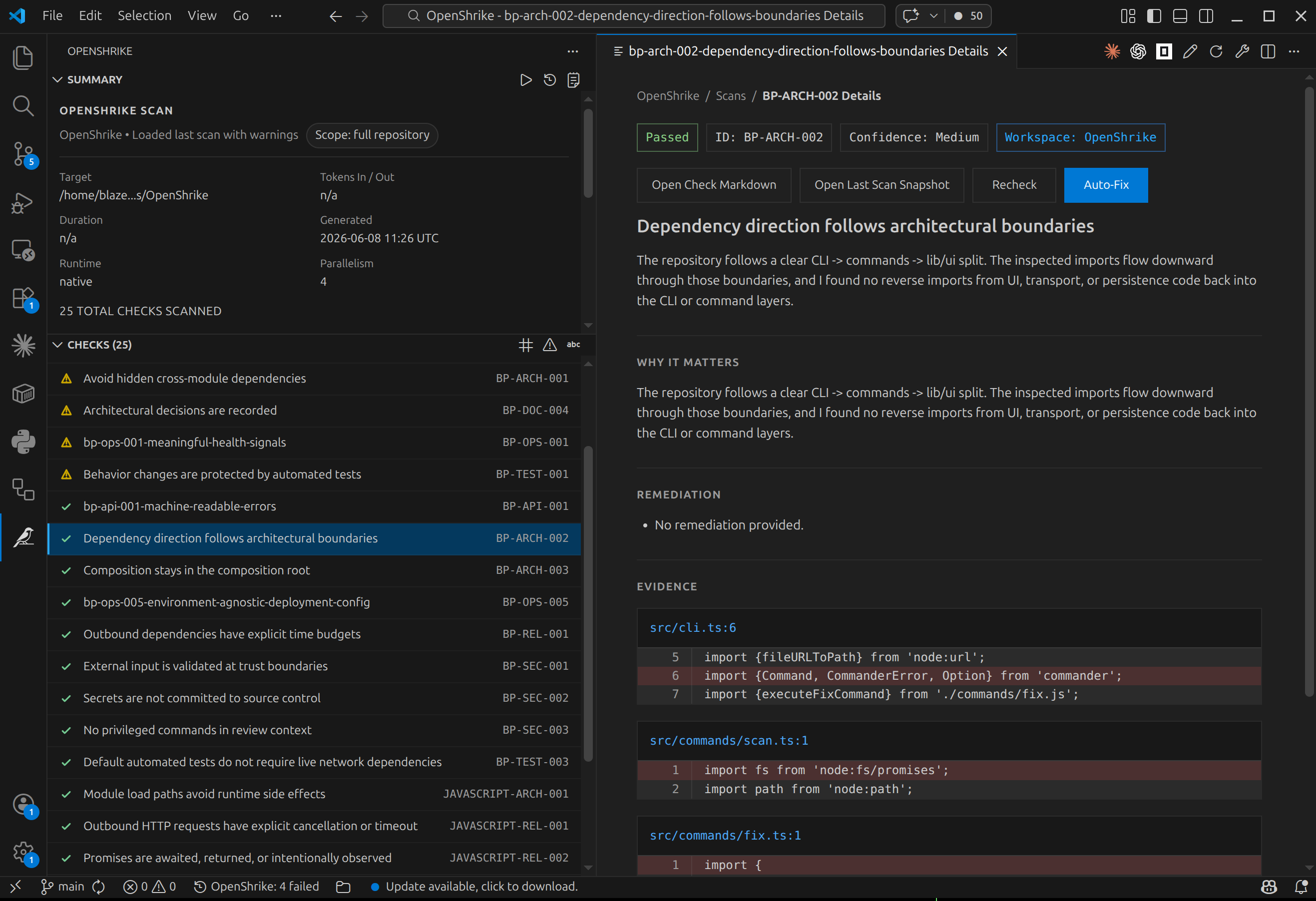
Start with 220 checks across nine engineering domains. Choose the practices that fit your project, then adapt them to your team’s standards.
Explore the best-practice library →Boundary validation, error contracts, compatibility and idempotent mutations.
Timeouts, retries, idempotency, resource lifecycles and graceful failure.
Boundaries, dependency direction, encapsulation and explicit entrypoints.
Health signals, safe automation, telemetry and production defaults.
Deterministic, isolated tests that assert outcomes through supported interfaces.
Hot-path data access, quadratic work, async blocking and latency signals.
Atomic mutations, schema evolution, provenance and validated upstream data.
Input validation, authentication, authorization, secrets and safe data handling.
Public APIs, behavior changes and release notes stay documented.
Bring your own key and choose the model that fits your team. OpenShrike uses OpenCode as its agent harness and supports cloud and local providers.
Install OpenShrike, choose your policies and run your first scan. Keep your standards in the repo and make them part of how your team builds.
npm install -g @networkperspective/openshrike

